Tried this recipe?Please rate the recipe by clicking the stars below
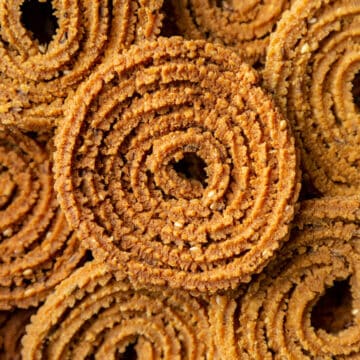
Chakli Recipe
Chakli is a spiral shaped savory snack made from rice flour, besan (gram flour), and spices. These fried and crunchy snacks are usually made for Diwali and pair perfectly with some hot cup of tea (chai). Vegetarian and Gluten-free!
Equipment
- Chakli Maker (Press)
Ingredients
- 1 cup rice flour 160 grams
- ½ cup besan 50 grams
- 1 teaspoon chilli powder adjust to taste
- ¼ teaspoon turmeric powder
- 1 teaspoon coriander powder
- ⅛ teaspoon asafoetida hing
- ½ teaspoon carom seeds ajwain
- 1 teaspoon cumin seeds zeera
- 1 teaspoon sesame seeds til
- 4 tablespoons ghee hot
- 1 teaspoon salt adjust to taste
- ½ cup hot water or as needed
Want to save this recipe?
Instructions
To make the dough
- In a large mixing bowl, sift the rice flour and gram flour.
- To it, add the spices (red chili powder, coriander powder, turmeric, hing (asafoetida), salt), and seeds (carom seeds (ajwain), cumin seeds (zeera), and white sesame seeds (til)). Mix with a spoon (or spatula) to combine.
- Heat ghee (or oil) on stovetop or microwave and add to this dry mix.
- Incorporate the ghee (oil) into the flour using a spoon first (since it's hot), then go in with your hands. It will form a crumbly texture, and the color will change to orangish-yellow.
- Boil the water and use it, a little at a time, to knead into a firm, pliable dough (not too tight or too loose). Used approximately half a cup of hot water. You may need a few tablespoons more.
- Rest for 5-10 mins by covering with a wet cloth. Don’t rest for too long as it may get dry.
To make chakli
- Give the rested dough a quick knead one more time and then divide into 2-3 equal portions (portions can vary depending on the size of your chakli maker)
- Take the chakli press and add the star disk to it so it's flat and seals the bottom.
- Add one portion of the dough, press so it fits inside the tube. Close and tightly secure the lid/handle of the chakli maker.
- Use a silicon mat or line a plate or baking sheet with parchment paper or cut individual parchment paper squares for each chakali. This makes the transfer to oil easy.
- Press the chakli maker to squeeze out the dough and then move in a circular motion to make spirals.
- Make about 4-5 spirals, close to each other for each chakli.
- Break the dough and seal the outside and inside edge (i.e start and end) to prevent them from opening while frying.
- Continue similarly pressing the remaining chaklis. Keep these covered to prevent drying.
To fry:
- Heat oil in a frying pan and test the temperature by adding a small piece of the dough. It should rise gradually over a few seconds, indicating that the oil is ready. If it rises too fast then the oil is very hot and if the dough sit at the bottom then the oil is still cold and needs to heat up more.
- Line a baking tray or plate with a paper towel and keep it ready.
- Gently lift the chakli using a spatula and transfer it to the hot oil. Add 3-4 pieces of chakali or as many as the pan can hold without overcrowding.
- Fry on medium-low heat until golden, flipping in between so both sides are cooked. Drain and then transfer to the lined plate to drain excess oil. Keep similarly frying the remaining chaklis.
- Crispy and crunchy chaklis are ready!!
- Allow the chaklis to cool completely, they will harden further as they cool. Store airtight at room temperature for 3-4 weeks.
Video
Notes
For the dough:
- For those crispy, crunchy chaklis, add hot fat (oil, ghee, or butter) to the dough and incorporate it into the flour before kneading.
- Please don't skip the seeds! Cumin, sesame, and ajwain add both a nice crunch and flavor. In addition, ajwain aids digestion too.
- For spicier chakali, add some more chili powder. Taste a small portion of the dough to check.
- Keep the dough and shaped chaklis covered at all times with a wet cloth to prevent them from drying.
- Use a chakali maker or chakli press. I got mine from India, but there are many varieties available online and in local Indian stores.
- Ensure the dough is firm yet pliable (not too tight, loose, crumbly, or sticky). Don't rest it for long.
- If the dough is too tight and breaks easily while piping, add a couple of teaspoons of water, knead, and try again. Less water will cause the chakali to break while piping. Some strands will break occasionally, and that's ok. I add them back to the dough.
- If the dough is too soft, sticky, or moist, add some more rice flour (a tablespoon at a time), knead, and try again. Too much moisture will make the dough soft and cause the chakali to lose shape.
- Making those perfect circles is not difficult at all and can be mastered with some practice and patience.
- If you find it challenging to make spirals, make small 2-3 inch lines instead. These are known as tukda chakali and taste just the same, though they are bite-sized and not round.
- Fry on medium to medium-low heat. To test, drop a small piece of dough: it should sizzle gently and rise slowly to the surface. If it sinks, the oil is cold. If it browns too fast, the oil is too hot.
- When the oil is sufficiently hot, the chakli will gradually sizzle and rise to the top. If the oil is not hot, it will sink to the bottom.
- Frying at a high temperature will cause the outside to brown quickly and the inside to remain uncooked, resulting in unpleasant results like being crunchy on the outside and soft on the inside.
- Similarly, frying at low temperatures will turn them hard, not crispy.
- Always test the oil temperature before frying the next batch.
- Check the first batch of chakli before frying all of your dough. If the chakli appears to have absorbed oil or breaks in the oil, try adding 1 to 2 tablespoons of rice flour to the dough at a time, kneading after each addition. When you’re sure the dough is perfect, only then fry the next batch of chakli in the hot oil.
Nutrition
Calories: 87kcal | Carbohydrates: 10g | Protein: 2g | Fat: 4g | Saturated Fat: 2g | Polyunsaturated Fat: 0.3g | Monounsaturated Fat: 1g | Cholesterol: 10mg | Sodium: 151mg | Potassium: 47mg | Fiber: 1g | Sugar: 0.4g | Vitamin A: 40IU | Vitamin C: 0.05mg | Calcium: 7mg | Iron: 0.4mg
Tried this recipe?Mention @shwetainthekitchen or tag #shwetainthekitchen!
Follow me on YouTube!Subscribe to my channel to get the latest Recipe Video updates.
