Tried this recipe?Please rate the recipe by clicking the stars below
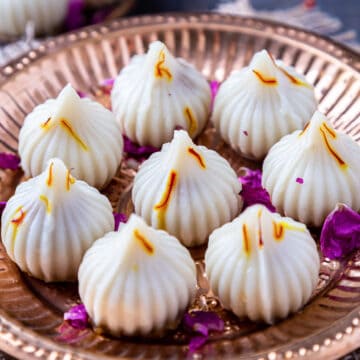
Ukadiche Modak Recipe
Ukadiche Modak are steamed rice flour dumplings filled with a sweet coconut-jaggery mixture flavored with cardamom, nutmeg, and saffron. Made especially for Ganesh Chaturthi, they are considered Lord Ganesha’s favorite sweet and are best enjoyed warm with a drizzle of ghee.
Equipment
Ingredients
For the Coconut-Jaggery Filling (Saran)
- 1 cup grated coconut Fresh or Frozen and thawed
- ½ cup jaggery grated
- ½ teaspoon cardamom powder
- ⅛ teaspoon nutmeg powder freshly grated, optional
- pinch saffron optional
- 10-12 cashews coarsely chopped, optional
Want to save this recipe?
Instructions
Prepare the Coconut-Jaggery Filling
- Heat a heavy-bottomed pan over medium heat. Add the grated coconut and cook for 3–5 minutes, stirring frequently, until the excess moisture evaporates. Do not brown the coconut.
- Reduce the heat to low and add the grated jaggery. Cook, stirring continuously, until the jaggery melts and combines with the coconut.
- Add the cardamom, nutmeg, saffron, and chopped cashews. Continue cooking until the filling is moist and slightly sticky but no longer watery. Do not overcook it, as it will firm up as it cools.
- Turn off the heat, transfer the filling to a bowl, and let it cool completely.
Prepare the Rice Flour Dough
- In a pot, bring 1 cup of water to a rolling boil. Add 1 teaspoon ghee and salt (optional).
- Reduce the heat to low and add the rice flour. Mix immediately until the flour absorbs the water and forms a lumpy mixture.
- Cover the saucepan, turn off the heat, and let the mixture rest for 5 minutes.
- Transfer it to a wide plate and let it cool just until it is comfortable to handle.
- While the dough is still warm, add the remaining 1 teaspoon of ghee and knead by hand for about 5 minutes. Add warm water, 1 teaspoon at a time, as needed, until the dough is soft, smooth, pliable, and crack-free.Alternatively, transfer the warm dough (ukad) to a stand mixer fitted with the paddle or hook attachment and mix on low speed for 2–3 minutes, until smooth and pliable. Finish by kneading it briefly with greased hands until completely smooth.
- Divide the dough and cooled filling into 16 equal portions. Keep the dough covered with a damp cloth throughout the shaping process.
Shape Modak Using a Mold
- Grease the inside of the modak mold with ghee.
- Place one dough ball inside and close it. Press the dough evenly against the sides of the mold, leaving the center hollow.
- Add one portion of filling without overfilling. Seal the opening completely with the excess dough.
- Open the mold and gently remove the modak. Place it in a greased steamer basket or on a plate and keep it covered.
- Repeat with the remaining portions, greasing the mold as needed.
Shape Modak by Hand
- Lightly grease your palms and fingertips with ghee or moisten them with water.
- Take one dough ball and roll it between your palms until completely smooth.
- Press your thumb into the center of the ball. Slowly rotate the dough while pressing it between your thumb and fingers to form a small cup.
- Gradually thin the sides and edges while keeping the bottom slightly thicker.
- Place one portion of the coconut-jaggery filling in the center, leaving enough space around the top to close the modak.
- Pinch the edge between your thumb and index finger to create the first pleat. Continue around the edge to form approximately 7-9 evenly spaced pleats.
- While gently rotating the modak, bring all the pleats together over the filling and pinch them firmly to seal.
- Shape the sealed top into a small point and remove any excess dough.
- Place the modak in the prepared steamer basket and keep it covered while shaping the rest.
Steam the Modak (Stovetop)
- Bring 2 cups of water to a boil in your preferred steamer.
- Dip or lightly sprinkle modak with water. Arrange the modak in the greased steamer basket, leaving some space between them (I steam 7 to 8 modaks at a time). Add a strand of saffron to each modak.
- Cover and steam for 10–12 minutes on medium-low heat, or until the covering looks slightly glossy.
- Turn off the heat and let the modak rest for 5 minutes before carefully transferring them to a plate. Serve warm, drizzled with ghee.
Steaming Modak in the Instant Pot Pressure Cooker
- Bring 2 cups of water to a boil using Sauté mode.
- Place the steamer basket with modak on the trivet. Cancel Sauté mode.
- Close the lid with the valve in the Venting position. Select Steam mode and steam for 10 minutes. Use an external timer to keep track of time.
- After 10 minutes, open the Instant Pot and carefully remove the steamer basket, and let the modak cool for 5 minutes to prevent the base from breaking. Transfer the modak to a serving platter. Serve warm, drizzled with ghee.
Video
Notes
Coconut-Jaggery Filling
- Fresh coconut gives the best texture, but frozen coconut works well too. Thaw it completely before using.
- Cook the filling until moist and slightly sticky, with no excess liquid remaining.
- Do not overcook the filling, as it will firm up further as it cools.
- Let the filling cool completely before assembling the modak.
- If the filling becomes hard, add 1–2 tablespoons of water and warm it gently until softened.
- Use fresh, finely ground rice flour. Sift it if it appears coarse or contains lumps.
- For steaming, start with a 1:1 ratio of water to rice flour. Rice flour absorbs water differently depending on the brand. If the dough feels dry or cracks, knead in warm water, 1 teaspoon at a time.
- Knead the dough while it is still warm until soft, smooth, and crack-free.
- For easier kneading, use a stand mixer fitted with the paddle or hook attachment to knead the warm dough (ukad).
- If the dough is sticky, knead it for another minute. If needed, add 1 teaspoon of rice flour at a time.
- Keep the dough covered with a damp cloth throughout shaping.
- Keep the covering thin and even. A thick covering can remain dense or chewy, while an excessively thin one may tear.
- If the dough cracks while shaping, smooth the area with moist fingers. If it keeps cracking, knead a few drops of warm water into the dough.
- Take your time while assembling the modak, as rushing can tear the delicate covering.
- Use modak molds; they make shaping easier and create more uniform modak than hand-shaping.
- Avoid oversteaming, as it can make the rice flour covering chewy.
- My Mom's tip: dip the modak in water before steaming for a soft, melt-in-your-mouth modak.
- Freshly steamed modak are delicate, so handle them gently while transferring them from the steamer.
Nutrition
Serving: 1modak | Calories: 109kcal | Carbohydrates: 16g | Protein: 1g | Fat: 5g | Saturated Fat: 4g | Polyunsaturated Fat: 0.2g | Monounsaturated Fat: 1g | Cholesterol: 2mg | Sodium: 39mg | Potassium: 43mg | Fiber: 1g | Sugar: 7g | Vitamin A: 0.02IU | Vitamin C: 0.1mg | Calcium: 6mg | Iron: 0.3mg
Tried this recipe?Mention @shwetainthekitchen or tag #shwetainthekitchen!
Follow me on YouTube!Subscribe to my channel to get the latest Recipe Video updates.
