Tried this recipe?Please rate the recipe by clicking the stars below
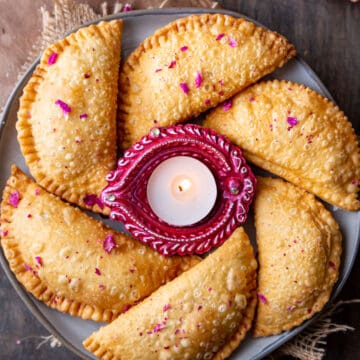
Karanji Recipe
Karanji is a crispy, fried pastry stuffed with a sweet filling of coconut, wheat flour, poppy seeds, nuts, and cardamom. These Maharashtrian sweet snacks are usually made during Diwali.
Equipment
Ingredients
For the outer covering:
For the Filling (Saran)
- 1 cup dry coconut powder
- 2 tablespoons poppy seeds khuskhus
- ½ tablespoon ghee
- ¼ cup wheat flour
- ¾ cup white granulated sugar (powdered) pithi sakhar, adjust to taste
- ¼ teaspoon cardamom powder
- 10 cashews roughly chopped
- 2 tablespoons golden raisins
Want to save this recipe?
Instructions
Make dough for the outer covering:
- In a mixing bowl, add all-purpose flour (maida), salt, and semolina (rava or sooji). Give it a quick stir.
- Heat ghee on stovetop or microwave for 30 secs. Add the hot ghee to the flour mixture and mix so it's evenly distributed in the flour mixture.
- Using water (or milk), knead into a firm (stiff) dough. Cover with a wet cloth and keep aside for 15-20 mins. While the dough is resting make the saran (coconut filling)
Make the filling :
- Heat a frying pan on medium-low heat and roast the dry coconut powder until golden. Transfer to a bowl.
- Similarly, roast the khuskhus (poppy seeds) and transfer to the bowl with coconut.
- Add ghee and wheat flour to the pan and fry until fragrant and golden. Keep stirring continuously to avoid burning the flour. Transfer the roasted wheat flour to the bowl too.
- Add cashews, raisins, and cardamom powder to the roasted coconut mixture. Allow too cool slightly.
- Add the powdered sugar and mix well. The filling (saran) is ready. Keep aside. This filling can be made ahead and stored refrigerated until ready to use.
Roll, stuff and shape Karanji :
- Divide the rested dough into two parts. Roll each part into a log. Cut each log into 8 equal parts.
- Take one part and keep the remaining covered with a wet cloth. Roll it between your palms to make it smooth and round.
- With a rolling pin, roll the dough round in a 4 to 5 inches diameter circle. For those same sized karanjis, use a round pastry cutter or jar lid or Katori to cut the rolled dough round.
- Place a 1-2 tablespoons of the filling in the center of the circle leaving the sides clear. Do not over stuff.
- Apply a thin layer of water around the circumference of this rolled dough.
- Close & form a half-moon (semicircle) shape. Press the edges to seal completely. If not sealed properly, it will open up while frying and make the oil messy.
- Using a karanji cutter cut around the sealed dough area to form an even shape. To make a pattern, press the edges using a fork.
- Place the karanji on a plate and cover with a wet cloth to prevent from drying. Make all karanjis this way before frying them.
Deep fry the Karanji:
- Line a plate or baking tray with tissue paper and keep it ready.
- Heat oil (or ghee or a mix of both) in a frypan on medium to medium low heat. Test the oil by dropping a small portion of the dough. It should sizzle right back up without quickly browning.
- Once the oil is hot, slide 1-2 karanji into the oil. Do not overcrowd.
- Fry one side and then flip when golden. Similarly, fry the other side too until golden and crisp. The karanji will puff while frying. If they start to brown, lower the heat.
- Drain using a slotted spatula and then transfer to the lined plate to drain excess oil.
- Crispy, flaky, sweet coconut Karanji is ready, enjoy them as dessert or snacks with your tea! Serve warm or room temperature. Cool completely and store airtight.
Video
Notes
Add hot ghee to the flour: incorporate ghee in the flour before adding water. This helps helps create a flaky texture (khuskhushit Karanji).
Dough Consistency: Make sure the dough is firm yet pliable. If it's too soft, the karanji will absorb more oil while frying. Adding enough ghee to the dough
Rest the Dough: After kneading, let the dough rest for at least 15-20 minutes. This helps relax the gluten, makes rolling easier, and gives the karanji a better texture.
Thin Rolling: Roll out the dough into thin circles. If the rolled dough is too thick, the karanji will be less crisp.
Roast the Filling: roast the coconut, poppy seeds, and wheat flour to bring out their flavors and remove any excess moisture. This helps prevent the filling from becoming soggy.
Seal Properly: Ensure the edges are sealed tightly to prevent the filling from spilling out during frying, making the oil muddy. If this is to happen, filter the oil to remove the particles and then start frying again. Be careful while handling hot oil.
Frying Temperature: Fry the karanji on medium to medium-low heat. If the oil is too hot, the outer layer will cook too quickly, leaving the inside raw. Frying them on very low heat will cause them to turn soft. Frying on medium-low heat ensures even cooking and a golden-brown color.
Nutrition
Calories: 247kcal | Carbohydrates: 31g | Protein: 4g | Fat: 12g | Saturated Fat: 9g | Polyunsaturated Fat: 1g | Monounsaturated Fat: 1g | Cholesterol: 6mg | Sodium: 67mg | Potassium: 52mg | Fiber: 1g | Sugar: 12g | Vitamin C: 0.1mg | Calcium: 21mg | Iron: 1mg
Tried this recipe?Mention @shwetainthekitchen or tag #shwetainthekitchen!
Follow me on YouTube!Subscribe to my channel to get the latest Recipe Video updates.
